One Firm. Its Own Deployment.
A model-serving environment reserved for your organization. Define the hosting and capacity your firm needs before implementation.
CYPRESS AUTOMATION GROUP CONSULTING
Cypress Automation Group designs and deploys private large language model (LLM) environments for individual CPA firms. Each engagement has its own scope and pricing based on the firm's hosting, access controls, and workflow requirements. A private LLM deployment is not included in a Themis membership.
A model-serving environment reserved for your organization. Define the hosting and capacity your firm needs before implementation.
Define which firm materials the deployment can use, who can access them, and how the information is handled and retained.
Give professionals evidence they can check. Private deployment supports confidentiality; source verification and professional judgment remain essential.
BEFORE THE FIRST UPLOAD
A preparer uploads a client’s return to AI and gets an answer in seconds. Where did the confidential data go?
Before confidential information enters an AI workflow, your firm should be able to explain who receives it, what they may do with it, and how the resulting work is reviewed.
Understand the professional obligations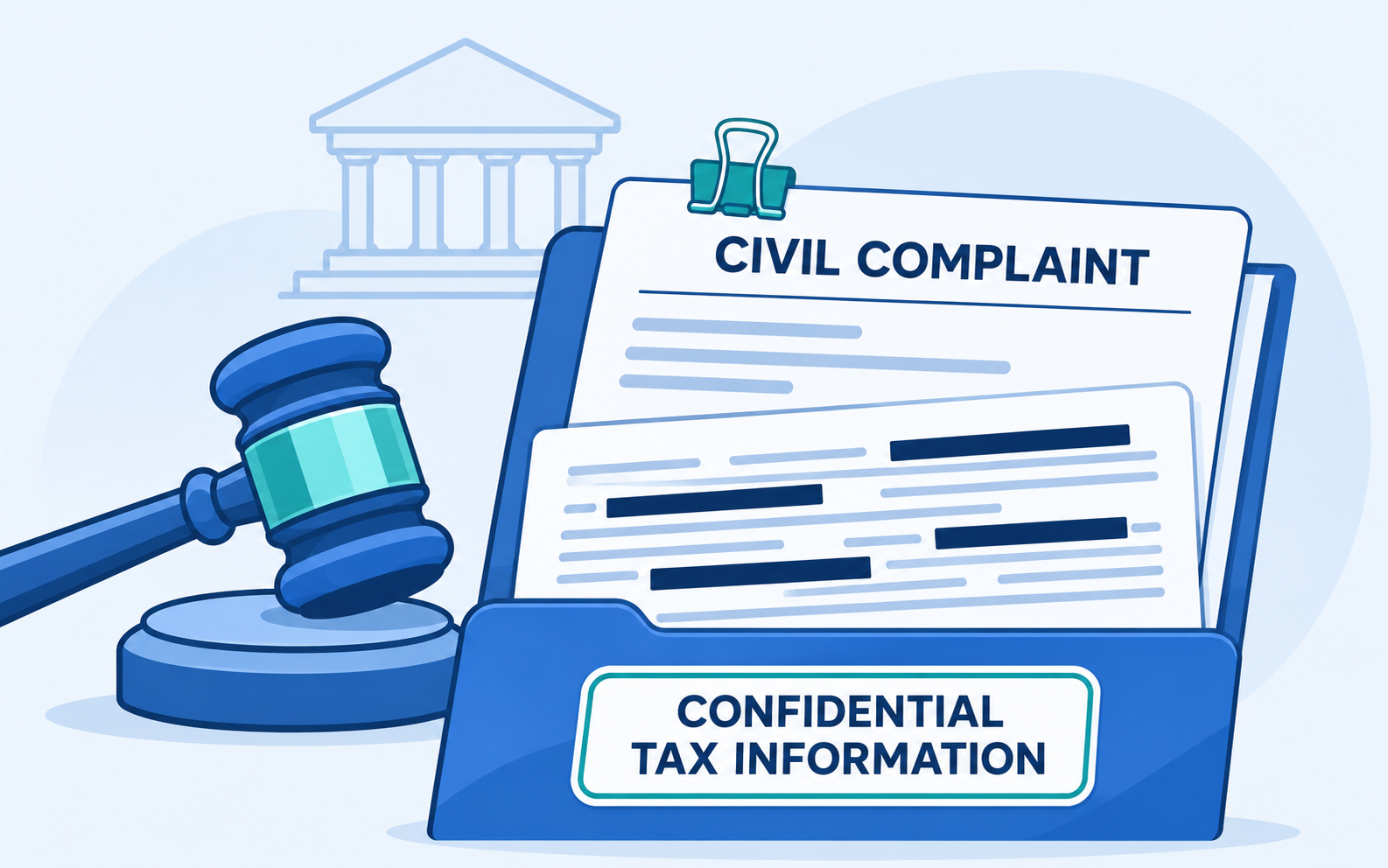
Include providers, support staff, and connected services.
Check documents, prompts, responses, logs, and backups.
Confirm training, secondary use, and processing terms.
Keep the sources and the review record available.
THE PROFESSIONAL STAKES
Improper disclosure, weak oversight, and unsupported advice can expose a firm to professional, financial, and reputational consequences. The circumstances and applicable rules matter.
Tax return information may be disclosed to an unauthorized recipient or used for an unauthorized purpose. IRC §§ 7216 and 6713 address improper use or disclosure, subject to applicable permissions and exceptions.
KNOW WHERE INFORMATION GOESOutsourcing AI processing does not remove your oversight duties. Covered tax preparation firms must evaluate service-provider safeguards and establish appropriate contractual expectations.
VERIFY THE SAFEGUARDSA confident answer may contain an invented citation, outdated authority, or incorrect facts. Review AI-assisted analysis against the client's facts and the original authorities before relying on it.
CHECK THE WORK BEFORE USEWithout a record of sources, access, and review, explaining an AI-assisted decision becomes harder. Protect the client relationship with clear procedures and evidence of the work performed.
BE PREPARED TO EXPLAINYOUR FIRM'S PRIVATE ENVIRONMENT
Your proposal specifies the processing capacity reserved for your firm and identifies any shared infrastructure. It also defines who can access the deployment and which sources it can use.
Approved users, defined roles, and client-specific permissions.
Permitted client documents, firm procedures, and selected tax authorities.
Reserved for your organization, with documented processing, retention, and administrator access.
Your team checks the sources, resolves exceptions, and approves the work.
SPECIFIC COMMITMENTS, CLEAR RESPONSIBILITIES
Your deployment scope should answer these questions in writing. Your proposal specifies how users and systems connect, where information is processed, and what model processing capacity is reserved for your firm. It also sets out the terms for data use.
LOOK INSIDE THE RESEARCH
Follow an illustrative research workflow using a fictional Schedule K-1 question. See how a preparer can trace the analysis to its sources, review a worked example, and identify what still needs verification.
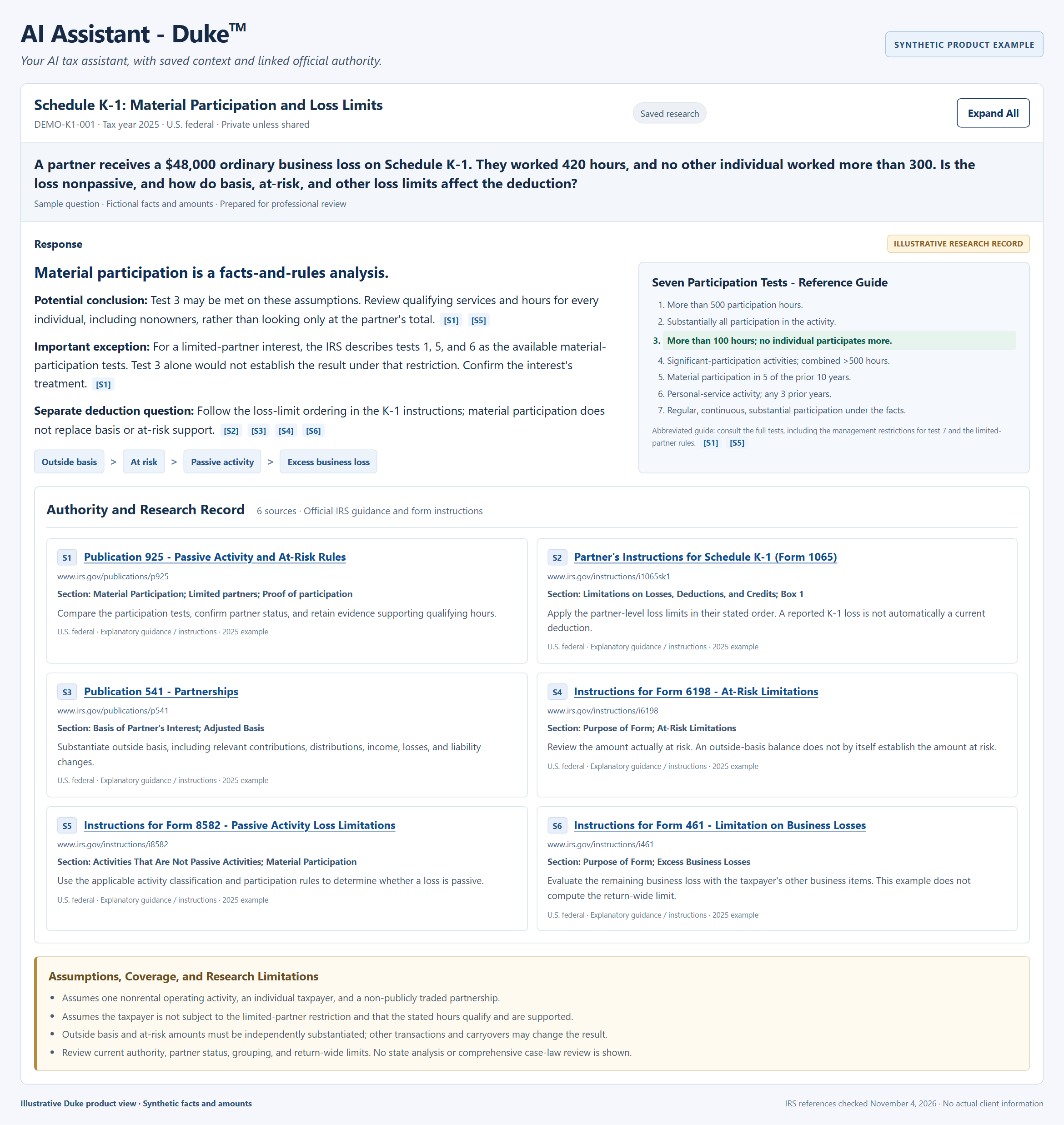
A useful tax answer should explain the applicable rule and the exceptions that might change the conclusion. In this example, the draft connects the participation tests to IRS guidance and flags the special treatment of limited-partner interests.
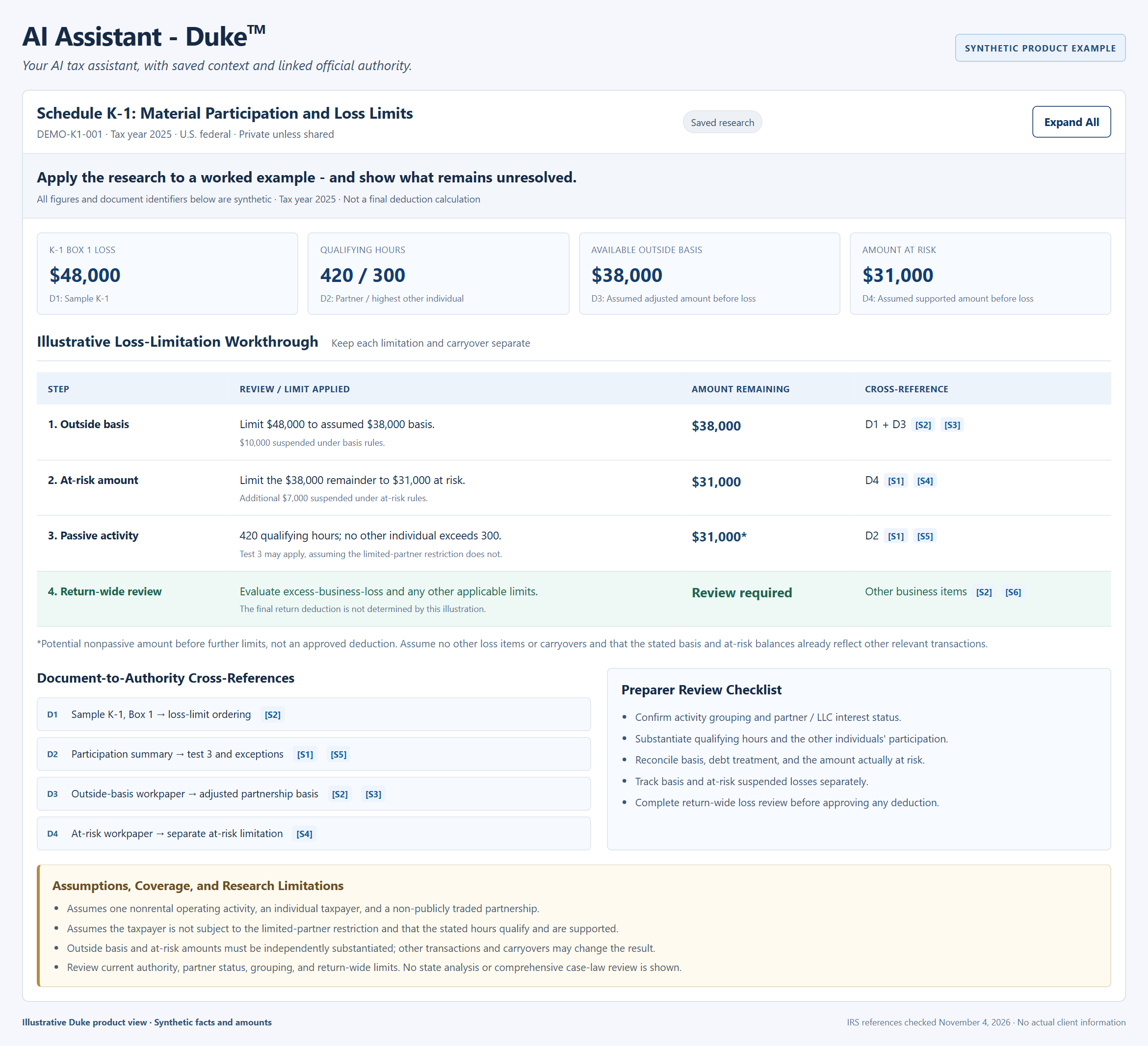
Material participation answers one part of the question. This illustration follows the remaining loss through separate limitations, identifies the assumed supporting documents, and keeps the final deduction unresolved until the preparer completes the review.
The images identify each source by its S-number. These links open the official IRS pages; verify the applicable edition, full rule, and facts before using the sample analysis.
CONTROL AND CORRECTNESS BOTH MATTER
Exclusive deployment addresses who uses the environment. Reliable professional work also requires current sources, sound permissions, tested workflows, and qualified oversight.
One firm's environment still contains different clients and staff roles. Verify permissions for retrieval, connected tools, and background processing.
A private model can still produce an incorrect answer or fabricated citation. Check the original authority, effective date, facts, and calculations.
Security monitoring, updates, incident response, and periodic testing remain necessary. Define who owns each responsibility for the life of the service.
FREQUENTLY ASKED QUESTIONS
No. Private LLM deployment is a separate consulting engagement with Cypress Automation Group. The proposal defines what's included and outlines implementation, hosting, and ongoing support costs.
The service is scoped around a model-serving deployment reserved for your organization, with defined access and knowledge boundaries. Your deployment agreement identifies the reserved resources, hosting arrangement, provider access, and any shared underlying infrastructure. A private network endpoint alone is not the same as an exclusive model instance.
Professional tax AI platforms can offer valuable research tools and strong privacy protections. Our dedicated service focuses on a firm-exclusive model deployment and the configuration of your firm's knowledge, permissions, and operating controls. Evaluate each offering by its architecture and written commitments rather than its use of the word “private.”
It should identify the exclusive model-serving resources, hosting, data flows, permissions, retention, support access, integrations, and operating responsibilities your firm is purchasing. Application access alone does not establish model exclusivity. We assess your requirements and define the implementation and ongoing scope before deployment.
A private deployment can use an existing base model. Approved documents can be retrieved when a permitted task needs them, without training the model on those records. Model selection, any customization, and restrictions on training or secondary use must be explicit in your service agreement.
The agreed data-flow design must identify all processing services, locations, integrations, and provider or support access. Hosting, monitoring, and connected services may involve third parties. We document those boundaries rather than make a blanket promise that no information ever leaves your premises.
Retention is defined for the selected deployment, including application records, model-service handling, logs, and backups. Your scope should identify retention periods, access, deletion procedures, and any provider requirements before client information is processed.
We assess your document sources, permissions, workflows, and available interfaces before agreeing integrations. Source licensing, data quality, access controls, and representative workflow testing determine what can be connected reliably.
Pricing depends on the model, reserved capacity, hosting, document volume, integrations, and support requirements. Your proposal separates implementation work from recurring infrastructure and service costs. Scope and commercial terms are agreed before deployment.
No. Firms remain responsible for confidentiality, diligence, and the work they deliver. Private deployment can support stronger control over processing, but it does not guarantee correct advice or automatic compliance. Staff must verify facts, check authorities, resolve exceptions, and review final work.
START WITH YOUR FIRM'S REQUIREMENTS
Tell us about your firm's confidentiality requirements, current workflows, and hosting preferences. We'll discuss what a private deployment would involve and what to include in a proposal.